
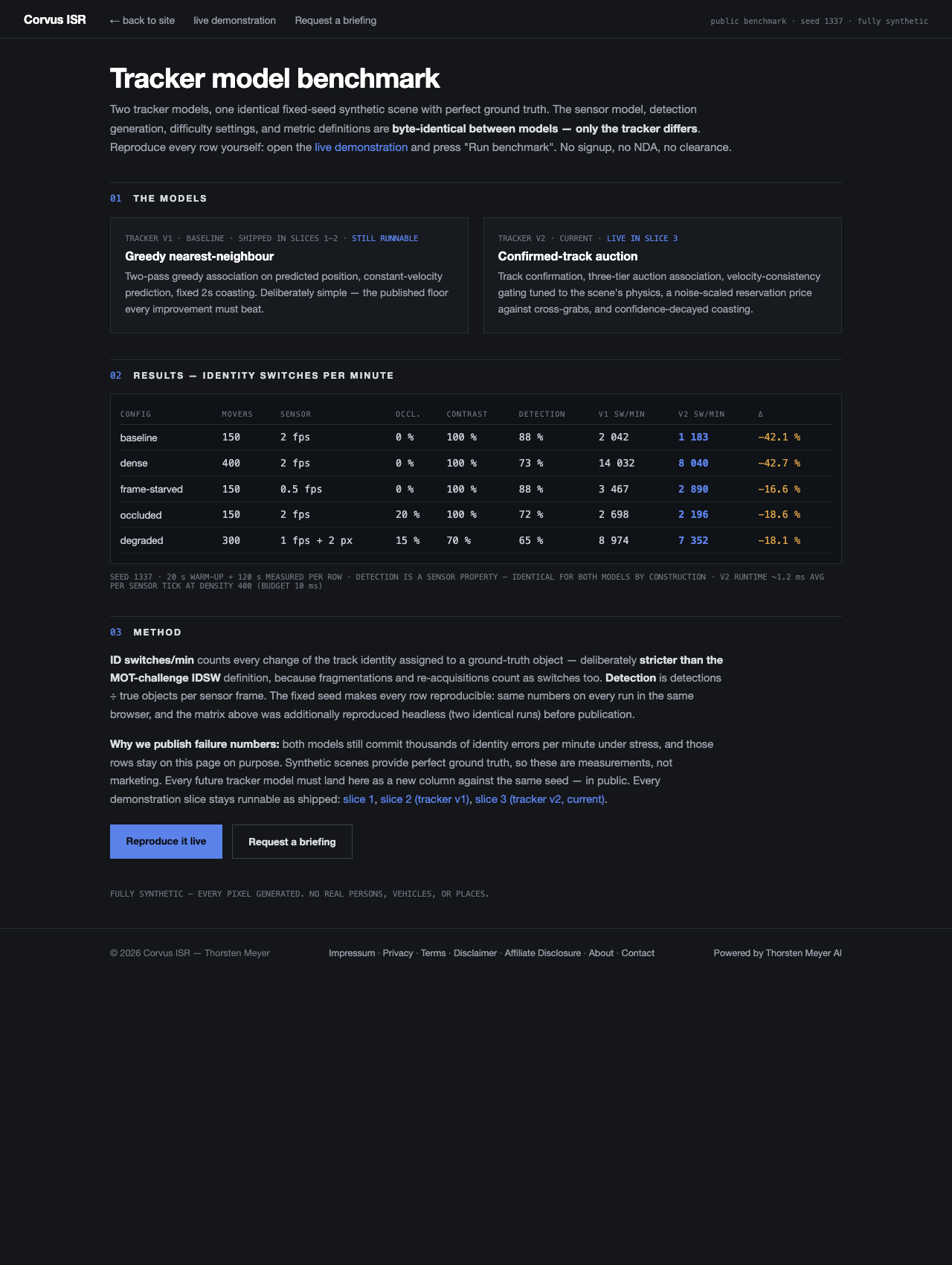
Corvus ISR has published a detailed PUBLIC TRACKER BENCHMARK comparing two distinct models in a synthetic, controlled environment. This benchmark uses a fixed-seed synthetic scene that guarantees perfect ground truth data, enabling precise measurement of each tracker’s performance without ambiguity. The synthetic setup ensures that every pixel, object, and movement is generated digitally, providing a reliable platform for scientific evaluation rather than marketing hype.

Prime made for students and young adults
- Fast, free delivery for dorm and study essentials
- Prime Video and Amazon Music included
- Member-only deals
The two models evaluated are: v1, a ‘greedy nearest-neighbour’ baseline using simple two-pass greedy association and constant velocity prediction, and v2, an advanced ‘confirmed-track auction’ system that incorporates a three-tier auction, velocity-consistency gating, and confidence-decayed coasting. Despite the simplicity of v1, the benchmark highlights how much better recent innovations can perform, especially under challenging conditions.
The results are striking: for a baseline scenario with 150 movers at 2fps, v1 recorded 2,042 ID switches per minute, which dropped to 1,183 with v2—a 42.1% reduction. In a denser scene with 400 movers, the ID switches decreased from 14,032 to 8,040, a 42.7% improvement. Even under degraded conditions like low frame rates, occlusions, and noisy data, v2 consistently outperformed v1, showing significant robustness gains. Importantly, the detection rate remains identical for both models since it depends solely on sensor properties.
Why does Corvus ISR publish these figures? Because every tracker still commits thousands of identity errors per minute under stress, even in perfect ground truth environments. These results are not marketing fluff; they are transparent measurements that hold every future tracker to a high standard. The published failure numbers demonstrate the importance of rigorous evaluation—something synthetic scenes excel at by offering flawless ground truth data, unlike real-world scenes which are inherently noisy and ambiguous.
From an engineering perspective, the v2 tracker processes about 1.2 milliseconds per sensor tick in scenes with 400 objects, comfortably fitting within a 10ms real-time budget. This efficiency is verified through the live demo where anyone can reproduce it live. The benchmark’s design is fully synthetic: no real persons, vehicles, or locations are involved—every pixel is generated, ensuring consistent, repeatable results for rigorous scientific analysis.
For science-minded readers, understanding the methodology behind these benchmarks is crucial. The use of perfect ground truth in synthetic scenes allows for an unambiguous assessment of each tracker’s true capabilities and failure modes. Publishing the failure numbers, as opposed to only successes, emphasizes a commitment to transparency and continuous improvement. By providing a fixed-seed matrix, Corvus ISR offers a reproducible testbed that anyone can run to verify results independently.
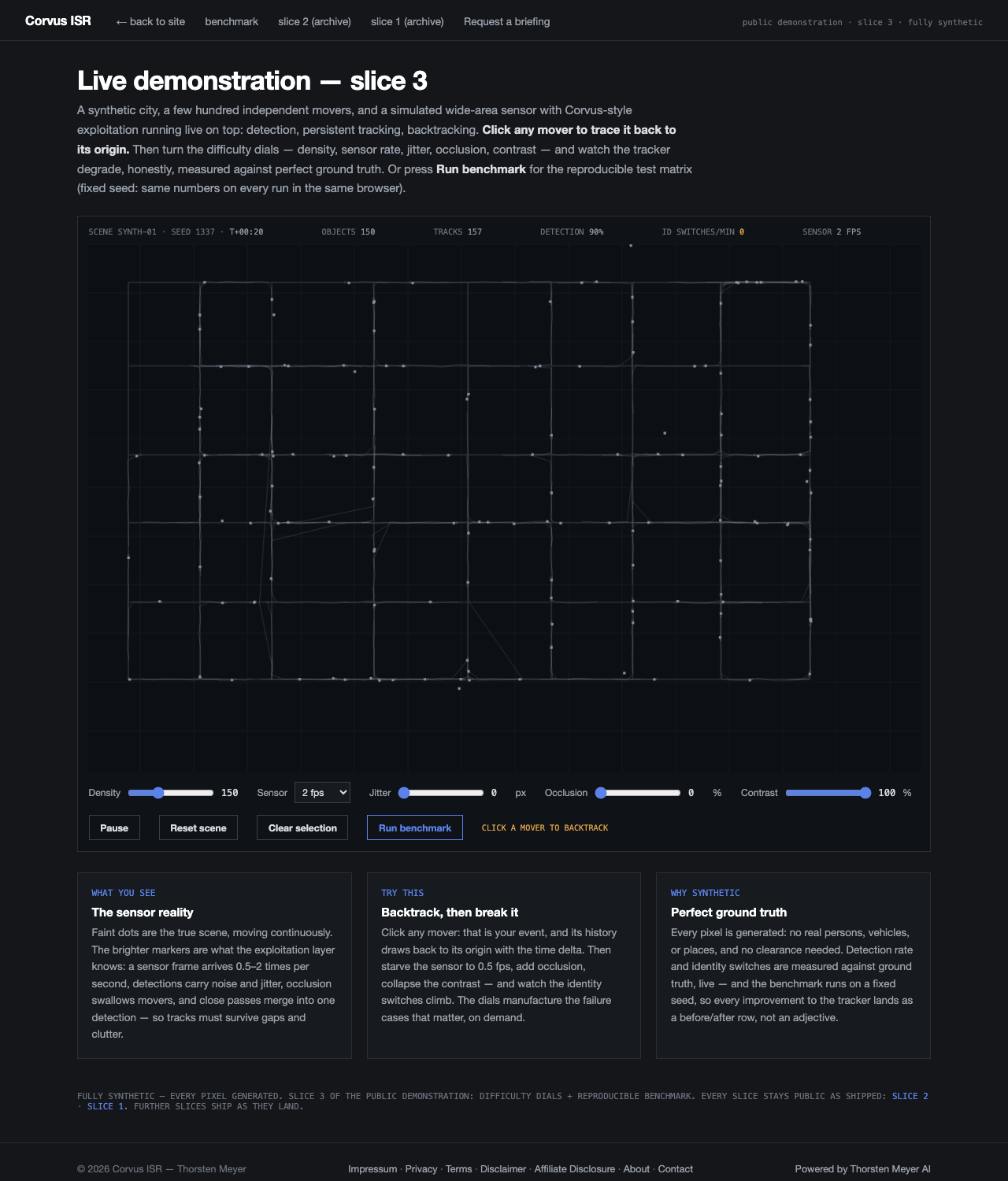
Readers are encouraged to explore the public benchmark and try reproduce it live. Running the benchmark yourself is straightforward and requires no signup or NDA, making it an excellent resource for researchers and developers aiming to evaluate their tracking systems under controlled, repeatable conditions. This level of openness fosters a scientific approach to advancing multi-object tracking technology.
multi-object tracking benchmark software
As an affiliate, we earn on qualifying purchases.
As an affiliate, we earn on qualifying purchases.
synthetic scene simulation tools
As an affiliate, we earn on qualifying purchases.
As an affiliate, we earn on qualifying purchases.
real-time object tracking sensors
As an affiliate, we earn on qualifying purchases.
As an affiliate, we earn on qualifying purchases.
As an affiliate, we earn on qualifying purchases.
Fall Picks
fall essentials
As an affiliate, we earn on qualifying purchases.