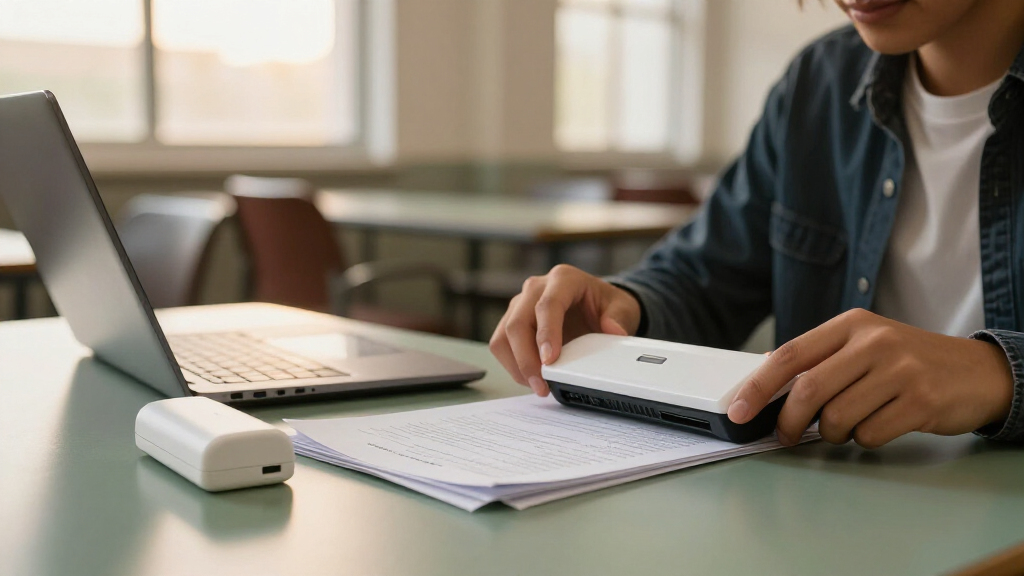
For most students, I’d start with the Canon imageFORMULA R10: its sheet-fed design and automatic double-sided scanning suit regular batches of class notes without demanding a bulky setup. The Brother DS-740D is a strong alternative if duplex scanning and a compact footprint matter most, while the Epson WorkForce ES-50 suits students who prioritize a simple, lightweight scanner for one page at a time. The main tradeoff is between batch convenience and portability: sheet-fed models handle stacks more easily, while handheld scanners can work without a computer but require more manual control. Connectivity, software compatibility, and whether you need to scan books or loose pages also change which option makes sense. Read on for the full breakdown and a guide to choosing a scanner that fits your study routine.

Prime made for students and young adults
- Fast, free delivery for dorm and study essentials
- Prime Video and Amazon Music included
- Member-only deals
Key Takeaways
- The Canon imageFORMULA R10 leads for everyday coursework because its sheet-fed workflow is a better match for batches of loose notes than handheld scanning.
- Duplex scanning separates the Brother DS-740D from simpler single-feed options: it can reduce the effort of digitizing double-sided handouts, though the DS-640 is the more basic Brother alternative.
- Compact does not always mean computer-free. Most sheet-fed models in this group connect to a computer, while the AOZBZ and Hczrc handheld scanners include memory-card-based workflows that trade automation for independence.
- The two ScanSnap iX1300 listings appear to be the same scanner in different colors. Students should compare their intended setup and included details rather than treat them as distinct performance choices.
- Specialized needs change the shortlist: the Epson RapidReceipt RR-60 is aimed at receipt organization, while the Plustek S410 Plus, Epson ES-C220, and other feed scanners suit students prioritizing document handling over handheld flexibility.
| Canon imageFORMULA R10 Portable Document Scanner | 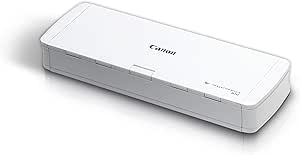 | Best Overall for Double-Sided Class Notes | Scanner type: Document scanner | Connection: USB | Resolution: 600 dpi | VIEW LATEST PRICE | See Our Full Breakdown |
| HPPS100 Portable USB Document and Photo Scanner |  | Best for One-Sided Pages and Mixed Media | Model: HPPS100 | Scanner type: Portable simplex sheetfed | Scanning speed: Up to 15 pages per minute | VIEW LATEST PRICE | See Our Full Breakdown |
| Epson WorkForce ES-50 Portable Document Scanner |  | Best for Searchable Study Files | Scanner type: Single-sheet-fed document scanner | Connection: USB 2.0 | Resolution: 1200 dpi | VIEW LATEST PRICE | See Our Full Breakdown |
| IRIScan Express 4 Portable USB Document Scanner |  | Best for Windows-Only Budget Setups | Scanner type: Business card, document, photo, and receipt scanner | Scanning mode: Simplex (single-sided) | Scan speed: Up to 8 pages per minute | VIEW LATEST PRICE | See Our Full Breakdown |
| Brother DS-740D Duplex Compact Mobile Document Scanner |  | Best for Fast Two-Sided Scanning | Scanner type: Business card and document scanner | Scanning speed: Up to 16 pages per minute | Duplex scanning: Single-pass | VIEW LATEST PRICE | See Our Full Breakdown |
| AOZBZ Portable Handheld Document Scanner, 900 dpi |  | Best for High-Resolution Handheld Scans | Resolution: 300, 600, or 900 dpi | File formats: JPEG, PDF | Storage: Supports microSD cards up to 32 GB; includes a 16 GB card | VIEW LATEST PRICE | See Our Full Breakdown |
| AOZBZ Portable A4 Document Scanner with 16GB SD Card |  | Best for Battery-Powered Capture | Scanning resolution: 300, 600, or 900 dpi | Color depth: 24 bits per pixel | File formats: JPEG, PDF | VIEW LATEST PRICE | See Our Full Breakdown |
| ScanSnap iX1300 Wireless or USB Double-Sided Color Document Scanner |  | Best for Duplex Study-Packet Scanning | Scanning speed: Up to 30 pages per minute | Duplex scanning: Automatic double-sided scanning | Connection: USB, Wi-Fi | VIEW LATEST PRICE | See Our Full Breakdown |
| Hczrc Portable Handheld Document and Photo Scanner, Up to 900 DPI, with 16 GB MicroSD Card |  | Best for Scanning Away from a Computer | Resolution: 300, 600, or 900 dpi | File formats: JPEG, PDF | Storage: Includes 16 GB MicroSD card; supports up to 32 GB | VIEW LATEST PRICE | See Our Full Breakdown |
| Brother DS-640 Compact Mobile Document Scanner |  | Best for Computer-Based Class Notes | Scan speed: Up to 16 pages per minute | Optical resolution: 300 dpi | Connection and power: USB; USB-powered | VIEW LATEST PRICE | See Our Full Breakdown |
| Plustek S410 Plus Portable Sheet-Fed Document Scanner |  | Best for Simple, USB-Powered Scanning | Scanner type: Sheet-fed document scanner | Connection and power: USB; 2.5 watts | Optical resolution: 600 dpi | VIEW LATEST PRICE | See Our Full Breakdown |
| Epson WorkForce ES-C220 Compact Duplex Document Scanner |  | Best for Scanning Class Packets | Scanner type: Duplex document scanner | Automatic document feeder: 20 pages | Scan speed: Up to 30 ppm / 60 ipm | VIEW LATEST PRICE | See Our Full Breakdown |
| ScanSnap iX1300 Wireless or USB Double-Sided Color Document Scanner, White |  | Best for Wireless Study Workflows | Scanner type: Document and receipt scanner | Connections: USB and Wi-Fi | Resolution: 600 dpi | VIEW LATEST PRICE | See Our Full Breakdown |
| Epson RapidReceipt RR-60 Compact Mobile Document Scanner |  | Best for Receipt and Expense Records | Scanner type: Receipt scanner | Connection: USB | Resolution: 600 dpi | VIEW LATEST PRICE | See Our Full Breakdown |
| portable document scanners for student | Weight | Scanner type | Resolution | Connection |
|---|---|---|---|---|
| Canon imageFORMULA R10 Portabl | 998 g | Document scanner | 600 dpi | USB |
| HPPS100 Portable USB Document | — | Portable simplex sheetfed | — | — |
| Epson WorkForce ES-50 Portable | 9.44 ounces | Single-sheet-fed document scanner | 1200 dpi | USB 2.0 |
| IRIScan Express 4 Portable USB | 0.5 kg | Business card, document, photo, and receipt scanner | 300 dpi | USB |
| Brother DS-740D Duplex Compact | 1.4 pounds | Business card and document scanner | 300 dpi | USB |
| AOZBZ Portable Handheld Docume | 170 g | — | 300, 600, or 900 dpi | USB 2.0 |
| AOZBZ Portable A4 Document Sca | About 0.31 lb | — | — | — |
| ScanSnap iX1300 Wireless or US | 4.4 lb | — | 600 dpi | USB, Wi-Fi |
| Hczrc Portable Handheld Docume | 9.6 oz | — | 300, 600, or 900 dpi | USB |
| Brother DS-640 Compact Mobile | 1 lb | — | — | — |
| Plustek S410 Plus Portable She | 0.41 kg | Sheet-fed document scanner | — | — |
| Epson WorkForce ES-C220 Compac | — | Duplex document scanner | — | — |
| ScanSnap iX1300 Wireless or US | 4.4 pounds | Document and receipt scanner | 600 dpi | — |
| Epson RapidReceipt RR-60 Compa | 16 ounces | Receipt scanner | 600 dpi | USB |
More Details on Our Top Picks
Canon imageFORMULA R10 Portable Document Scanner
For students who regularly scan lecture notes, readings, and handouts, I rank the Canon imageFORMULA R10 first because its automatic feeder and duplex scanning reduce the fuss of digitizing a stack of two-sided pages. It runs from USB power and includes software for Windows and Mac, making it a practical dorm-room or library companion without a separate power adapter or software installation. At up to 12 pages per minute, it is slower than the Brother DS-740D, but its built-in software and straightforward setup give it a more approachable everyday balance. The main limit is the 20-sheet feeder: large textbook chapters still need to be split into batches. It is also intended for documents rather than photo-paper prints, so students scanning artwork should choose a different tool.
Pros:- Duplex scanning captures both sides of pages without turning them over manually.
- USB power keeps the setup compact for dorms, libraries, and shared study spaces.
- Built-in software works on Windows and Mac without installation.
- A 20-sheet feeder handles small batches of class materials.
Cons:- The feeder requires reloading for larger reading packets or textbook chapters.
- It is not intended for scanning photographs printed on photo paper.
Best for: Students with a Windows or Mac laptop who often digitize two-sided lecture notes and modest stacks of course handouts.
Not ideal for: Students who need to scan large stacks without reloading, or who mainly want to digitize glossy photographs.
- Scanner type:Document scanner
- Connection:USB
- Resolution:600 dpi
- Duplex scanning:Yes
- Scanning speed:Up to 12 pages per minute
- Automatic feeder capacity:20 sheets
- Compatibility:Windows and Mac
- Dimensions:3.74 x 11.22 x 1.57 in
- Weight:998 g
Our verdict“Choose the R10 for a simple, well-rounded way to scan two-sided course documents on a Windows or Mac laptop.”
HPPS100 Portable USB Document and Photo Scanner
The HPPS100 suits students who scan a mix of course pages, receipts, and small photos, and who value broad paper-size support over automatic two-sided capture. Its 2 × 2.9 to 8.5 × 14-inch range covers small cards through legal-size sheets, while HP WorkScan adds auto-scan, editing, and image cleanup. The listed speed of up to 15 pages per minute is quicker than the IRIScan Express 4, which tops out at 8, though the HP still scans only one side at a time. That distinction matters when a professor distributes double-sided handouts: turning pages adds time that the duplex Canon R10 avoids. USB power and Windows/macOS support make it easy to pack, but it is better for small or medium batches than a full semester’s archive.
Pros:- Supports paper sizes from 2 × 2.9 inches up to 8.5 × 14 inches.
- Scans color and black-and-white pages at up to 15 pages per minute.
- HP WorkScan includes auto-scan, editing, and image cleanup tools.
- USB-powered design is convenient for portable study setups.
Cons:- Simplex scanning means students must feed each two-sided page twice or turn it over.
- Designed for small to medium batches rather than extended high-volume scanning.
Best for: Students who scan varied document sizes and occasional photos, and whose course materials are mostly single-sided.
Not ideal for: Students who frequently scan double-sided notes or need to process long stacks in one session.
- Model:HPPS100
- Scanner type:Portable simplex sheetfed
- Scanning speed:Up to 15 pages per minute
- Maximum resolution:1200 dpi
- Supported paper sizes:2 × 2.9 to 8.5 × 14 inches
- Connectivity:USB 2.0
- Compatible operating systems:Windows and macOS
- Software:HP WorkScan
Our verdict“Pick the HPPS100 if your scans are mostly single-sided and you want flexible paper-size handling with useful cleanup tools.”
Epson WorkForce ES-50 Portable Document Scanner
I’d choose the Epson WorkForce ES-50 when turning paper into useful digital study material matters more than feeding a stack automatically. Its included OCR software can create searchable PDFs and editable Word or Excel files, which helps students find a term in lecture notes or reuse information without retyping it. Each page scans in as little as 5.5 seconds, and the scanner accepts long documents up to 8.5 × 72 inches, a useful distinction for extended notes or unusual forms. Compared with the Canon imageFORMULA R10, the ES-50 is lighter and better suited to single-page mobility, but it has no multi-sheet feeder and cannot capture both sides in one pass. Software download and cloud features also require an internet connection.
Pros:- OCR supports searchable PDFs and editable Word or Excel files.
- At 9.44 ounces, it is easy to carry between classes and study spaces.
- Scans a page in as little as 5.5 seconds.
- Handles receipts, ID cards, and documents up to 8.5 × 72 inches.
Cons:- Feeds one sheet at a time, making multi-page assignments more hands-on.
- Requires a computer connection, and software downloads and cloud features need internet access.
Best for: Students who scan pages one at a time and want searchable PDFs or editable text for research and study.
Not ideal for: Students who routinely digitize stacks of two-sided handouts or need a scanner that works without a computer connection.
- Scanner type:Single-sheet-fed document scanner
- Connection:USB 2.0
- Resolution:1200 dpi
- Scanning speed:As fast as 5.5 seconds per page
- Maximum document size:8.5 × 72 inches
- Power:USB-powered; 2.1 watts
- Weight:9.44 ounces
- Compatibility:Windows and Mac
Our verdict“Choose the ES-50 if searchable, editable study files matter more to you than batch or duplex scanning.”
IRIScan Express 4 Portable USB Document Scanner
The IRIScan Express 4 is a straightforward fit for a Windows student who needs to digitize occasional single-sided notes, receipts, or business cards and wants OCR and PDF tools included. Its USB power avoids a separate adapter, while the bundled Readiris software can export to Word, PDF, and Excel. That software focus gives it a useful role beside the Epson ES-50, whose OCR also targets searchable and editable study files; the Epson is much quicker at up to 5.5 seconds per page, while this IRIScan reaches up to 8 pages per minute. The tradeoff is clear: simplex scanning means manual page handling, and the stated Windows compatibility excludes Mac users. Its 300 dpi resolution also trails the 1200 dpi figures listed for the Epson and HPPS100.
Pros:- USB-powered operation avoids carrying a separate power adapter.
- Included software provides OCR, PDF editing, and exports to Word and Excel.
- Handles documents, receipts, photos, and business cards.
- Scans color and black-and-white pages at the same listed speed.
Cons:- Single-sided scanning requires extra handling for two-sided class materials.
- Compatible with Windows, but not macOS.
- Its listed 300 dpi resolution is lower than the 1200 dpi specifications of the Epson ES-50 and HPPS100.
Best for: Windows students who scan occasional single-sided course pages and want bundled OCR and PDF editing software.
Not ideal for: Mac users, students who need duplex scanning, or anyone prioritizing faster page capture and higher listed resolution.
- Scanner type:Business card, document, photo, and receipt scanner
- Scanning mode:Simplex (single-sided)
- Scan speed:Up to 8 pages per minute
- Connection:USB
- Resolution:300 dpi
- Color depth:24 bits
- Weight:0.5 kg
- Compatibility:Windows; minimum system requirement Windows 7
- Included software:Readiris OCR, Readiris PDF, Twain Driver, Button Manager
Our verdict“Choose the IRIScan Express 4 for a Windows laptop and occasional single-sided scans, but skip it if you need Mac support or duplex capture.”
Brother DS-740D Duplex Compact Mobile Document Scanner
When double-sided course packets are a regular part of student life, the Brother DS-740D stands out for its single-pass duplex scanning and speed of up to 16 pages per minute. That makes it the fastest listed option here and a stronger choice for repeated stacks than the Canon imageFORMULA R10, which scans both sides too but is rated up to 12 pages per minute. Brother also supports Windows, Mac, and Linux, giving it wider operating-system reach than the Windows-only IRIScan Express 4. The tradeoff is that this compact scanner still depends on a computer and downloaded software for its scanning features; it is not a standalone capture device. Its 300 dpi resolution is also lower than the Epson ES-50 and HPPS100 listings, so students focused on high-resolution image capture may prefer those alternatives.
Pros:- Single-pass duplex scanning captures both sides without manually turning pages.
- Up to 16 pages per minute is the fastest listed speed in this group.
- Works with Windows, Mac, and Linux.
- Supports receipts, business cards, embossed cards, laminated cards, and plain paper.
Cons:- Scanning features require a computer and applicable software.
- Drivers and bundled software require an internet connection to download.
- Its listed 300 dpi resolution is lower than the Epson ES-50 and HPPS100 specifications.
Best for: Students with frequent two-sided handouts who want fast batch scanning and broad Windows, Mac, or Linux compatibility.
Not ideal for: Students who want standalone scanning, higher listed resolution, or a setup that avoids downloading software.
- Scanner type:Business card and document scanner
- Scanning speed:Up to 16 pages per minute
- Duplex scanning:Single-pass
- Connection:USB
- Resolution:300 dpi
- Standard sheet capacity:25 sheets
- Supported media:Business cards, embossed cards, laminated cards, plain paper, plastic cards, and receipts
- Weight:1.4 pounds
- Compatibility:Windows, Mac, and Linux
Our verdict“Choose the DS-740D if speed and single-pass duplex scanning are your priorities and you are comfortable using downloaded computer software.”
AOZBZ Portable Handheld Document Scanner, 900 dpi
I’d pick this AOZBZ when a student needs to capture a page away from a desk and wants more resolution control than a basic text scan usually needs. Its 300, 600, and 900 dpi settings let you choose between compact files for notes and finer detail for diagrams or images. Scans save directly to a microSD card as JPEG or PDF, so the scanner can work without a computer during capture; USB 2.0 handles connection afterward, with no preinstalled software required.
Compared with the Brother DS-640, this is lighter and more independent of a computer, but it lacks the Brother’s stated page-per-minute speed and sheet-fed approach. The tradeoff is manual control: steady movement matters, and uneven passes can make a scan less consistent. I’d skip it for frequent stacks of lecture handouts.
Pros:- Three resolution settings, including 900 dpi for detailed images
- Saves JPEG and PDF files directly to microSD
- Can capture scans without preinstalled software
- Includes a 16 GB SD card
Cons:- Manual scanning calls for a steady, even pass
- Not suited to quickly processing a stack of pages
- Capturing scans requires a microSD card
Best for: Students who occasionally scan textbook excerpts, diagrams, or receipts in places where a computer is not handy.
Not ideal for: Students who regularly digitize multi-page handouts or need consistent, hands-free page feeding.
- Resolution:300, 600, or 900 dpi
- File formats:JPEG, PDF
- Storage:Supports microSD cards up to 32 GB; includes a 16 GB card
- Connection:USB 2.0
- Sensor:CIS
- Weight:170 g
- Dimensions:10 × 1 × 1 in
- Compatibility:Windows XP or later; Mac OS 10.4 or later
Our verdict“Choose this AOZBZ for occasional, detailed scans on the move, but choose the Brother DS-640 for faster, computer-connected document work.”
AOZBZ Portable A4 Document Scanner with 16GB SD Card
This AOZBZ is a straightforward choice for students who want an A4-capable handheld scanner and memory included, without carrying a dedicated scanning unit. It offers 300, 600, and 900 dpi settings and saves color scans as JPEG or PDF to the supplied 16 GB SD card. Its small, roughly 0.31-pound body is easy to slip into a bag, and wireless scanning is listed alongside USB connectivity.
Compared with the closely related AOZBZ 900 dpi handheld scanner, the basic appeal is similar: portable capture and direct card storage. This model’s two-AA-battery power can be useful away from an outlet, but the batteries are not included. Its compatibility information is also narrower, naming Windows 2000 or later without specifying Mac support. I’d choose the Brother DS-640 instead for a computer-based workflow with a stated scan speed.
Pros:- Offers 300, 600, and 900 dpi settings
- Includes a 16 GB SD card for scan storage
- Compact handheld body weighs about 0.31 lb
- Saves scans as JPEG or PDF
Cons:- Requires two AA batteries, which are not included
- Listed system requirement names Windows but does not specify Mac support
- Manual handheld passes can be less consistent than sheet-fed scanning
Best for: Students who want a lightweight scanner for occasional A4 pages and can keep spare AA batteries in their bag.
Not ideal for: Mac users or students who need clearly specified cross-platform software support and dependable high-volume scanning.
- Scanning resolution:300, 600, or 900 dpi
- Color depth:24 bits per pixel
- File formats:JPEG, PDF
- Storage:Supports up to 32 GB microSD; includes a 16 GB card
- Connectivity:Wireless scanning, USB cable
- Power:Two AA batteries, not included
- Weight:About 0.31 lb
- Listed minimum system requirement:Windows 2000
Our verdict“Pick this AOZBZ if battery-powered, occasional A4 capture matters more than a clearly documented Mac workflow or automatic page handling.”
ScanSnap iX1300 Wireless or USB Double-Sided Color Document Scanner
For a student who scans whole readings rather than the occasional page, the ScanSnap iX1300 is the strongest workflow upgrade in this group. Its automatic duplex scanning captures both sides in one pass, and the listed speed of up to 30 pages per minute can cut down the time spent digitizing class packets. A 20-sheet capacity suits small batches, while USB or Wi-Fi connectivity gives students a choice of computer or mobile workflows. It also handles photos, receipts, cards, and some thicker items.
Compared with handheld AOZBZ models, this is far less dependent on a steady hand and better for repeated multi-page work. That capability comes with a clear portability cost: at 4.4 pounds, it is compact for a desktop scanner, not pocketable. It also relies on compatible software and operating systems, unlike the simpler card-based handheld approach. I’d skip it if scans are rare or you need a scanner to carry between classes every day.
Pros:- Automatic duplex scanning captures both sides of a page
- Scans up to 30 pages per minute according to the product data
- Connects by USB or Wi-Fi, including with mobile devices
- Handles documents, receipts, photos, and plastic cards
Cons:- Weighs 4.4 pounds, much more than the handheld options
- A 20-sheet capacity limits batch size
- Computer and mobile use depend on compatible software and operating systems
Best for: Students who regularly digitize double-sided readings, notes, and small batches of course documents at a desk or shared study space.
Not ideal for: Students who need a truly lightweight scanner for daily carry or only scan a few pages now and then.
- Scanning speed:Up to 30 pages per minute
- Duplex scanning:Automatic double-sided scanning
- Connection:USB, Wi-Fi
- Resolution:600 dpi
- Sheet capacity:20 sheets
- Weight:4.4 lb
- Dimensions:4.5 × 11.7 × 3.3 in
- Warranty:1-year depot warranty
Our verdict“Choose the ScanSnap iX1300 for frequent double-sided study-packet scanning, not for the lightest possible bag.”
Hczrc Portable Handheld Document and Photo Scanner, Up to 900 DPI, with 16 GB MicroSD Card
The Hczrc suits students who want to capture a page, receipt, or photo without setting up a computer first. It stores JPEG or PDF scans directly on the included 16 GB MicroSD card, and its 300, 600, and 900 dpi choices give some control over detail and file size. The listed Windows and Mac compatibility, plus no-software-installation operation, make it a more clearly described cross-platform handheld option than the AOZBZ A4 model.
Its 9.6-ounce weight keeps it easy to carry, but this convenience does not make it a fast way to digitize a reading list. Like the AOZBZ 900 dpi model, it relies on the user to move the scanner steadily across each page. Two AA batteries are required and are not supplied. Compared with the computer-connected Brother DS-640, it offers more capture independence but less clearly defined speed and document workflow support.
Pros:- Saves JPEG and PDF files directly to a microSD card
- Includes a 16 GB MicroSD card and supports up to 32 GB
- Three resolution choices, up to 900 dpi
- Listed for Windows XP or later and Mac OS 10.4 or later without software installation
Cons:- Two AA batteries are required and not included
- Manual movement can produce inconsistent scans if the pass is unsteady
- Less suited to scanning multi-page coursework quickly than sheet-fed models
Best for: Students who need occasional scans of notes, receipts, or photos and want files saved to a card for later transfer.
Not ideal for: Students who scan long packets often, need an included power source, or want a feed-through scanner connected to a computer.
- Resolution:300, 600, or 900 dpi
- File formats:JPEG, PDF
- Storage:Includes 16 GB MicroSD card; supports up to 32 GB
- Connection:USB
- Power:Two AA batteries, not included
- Weight:9.6 oz
- Dimensions:2 × 11 × 1.5 in
- Compatibility:Windows XP or later; Mac OS 10.4 or later
Our verdict“Choose the Hczrc for occasional computer-free capture across Windows and Mac, but prefer a sheet-fed scanner for routine course packets.”
Brother DS-640 Compact Mobile Document Scanner
The Brother DS-640 is the most practical fit here for students who want a compact scanner that connects directly to a laptop and turns paper into usable digital files. It scans color or black-and-white pages at up to 16 pages per minute and draws power through its USB connection, so there is no separate outlet or AA-battery supply to manage. Its support for OCR, email, files, and cloud services can help turn class handouts into searchable or shareable material.
Compared with the Hczrc handheld scanner, the DS-640 requires a computer during operation, but it offers a more structured workflow and a stated scan speed. It also supports Windows, Mac, and Linux, broadening its appeal across student laptops. Its 300 dpi optical resolution is less flexible than the 900 dpi settings on the handheld picks, and features such as image rotation are limited to PC. I’d choose the ScanSnap iX1300 instead for automatic duplex scanning.
Pros:- Scans at up to 16 pages per minute
- USB-powered, with no separate outlet required
- Supports Windows, Mac, and Linux
- Handles paper, receipts, business cards, and plastic cards
Cons:- Must connect to a computer to operate
- Optical resolution is listed as 300 dpi
- Some features, including image rotation, are limited to PC
Best for: Students who scan individual pages, IDs, receipts, or long documents to a Windows, Mac, or Linux computer.
Not ideal for: Students who want standalone scans saved to a memory card or need automatic two-sided scanning for frequent packets.
- Scan speed:Up to 16 pages per minute
- Optical resolution:300 dpi
- Connection and power:USB; USB-powered
- Weight:1 lb
- Dimensions:1.99 × 11.9 × 1.45 in
- Supported media:Plain paper, receipts, business cards, embossed, ID, laminated, and plastic cards
- Compatibility:Windows, Mac, and Linux
- Warranty:One-year limited warranty
Our verdict“Pick the DS-640 for portable, computer-based scanning with a stated speed and broad operating-system support; choose the ScanSnap iX1300 for duplex batches.”
Plustek S410 Plus Portable Sheet-Fed Document Scanner
The Plustek S410 Plus suits students who scan occasional handouts, receipts, ID cards, or business cards and want a device that draws power from a USB connection. Its automatic scanning and included OCR software can turn paper into searchable or editable files without requiring a large desktop setup. Compared with the Epson WorkForce ES-C220, it has no feeder for batch jobs, so multi-page readings mean feeding pages one at a time. Its very low weight and narrow body make it easier to stash in a backpack or dorm drawer, though it still needs a computer connection and has a listed minimum system requirement of Windows 7. I’d choose it for straightforward, small-batch scanning—not for students digitizing lecture packets every week.
Pros:- USB power means no separate power supply or batteries are required.
- Automatic scanning avoids repeated button presses.
- Included OCR can create editable or searchable files.
- Accepts paper, receipts, business cards, and plastic ID cards.
Cons:- One-sheet capacity makes large assignments slow to scan.
- The listed minimum system requirement is Windows 7, which may limit compatibility with some newer setups.
Best for: Students who scan individual notes, receipts, and ID cards at a desk or in a dorm and want a lightweight scanner powered by their computer.
Not ideal for: Students who regularly digitize multi-page readings or need a fast feeder; its standard capacity is one sheet at a time.
- Scanner type:Sheet-fed document scanner
- Connection and power:USB; 2.5 watts
- Optical resolution:600 dpi
- Standard sheet capacity:1 sheet
- Supported media:Paper, business cards, plastic ID cards, invoices, and receipts
- Dimensions:1.6 × 11.7 × 1.9 inches
- Weight:0.41 kg
- OCR software:Included
- Warranty:2 years
Our verdict“Choose the S410 Plus for lightweight, occasional scans from a computer, but pick a feeder-equipped model such as the Epson WorkForce ES-C220 for regular batches.”
Epson WorkForce ES-C220 Compact Duplex Document Scanner
For students who often bring home printed readings or need to digitize a stack of notes, the Epson WorkForce ES-C220 is the batch-friendly pick here. Its 20-page automatic feeder scans both sides in one pass, with speeds listed up to 30 pages per minute, so double-sided packets take less hands-on effort than they would on the single-sheet Plustek S410 Plus. It also handles cards and passports, while image adjustments and OCR support help produce cleaner, searchable files. The tradeoff is a more computer-centered setup: the supplied details mention neither Wi-Fi nor standalone operation. Compared with the wireless ScanSnap iX1300, the ES-C220 emphasizes feeder-based document throughput over flexible wireless and mobile scanning. It makes most sense for desk-based study workflows.
Pros:- 20-page automatic document feeder reduces manual page handling.
- Single-step duplex captures both sides in one pass.
- Listed speeds reach up to 30 ppm or 60 ipm.
- Supports documents, cards, and passports, with image adjustments and OCR software.
Cons:- No wireless connectivity is listed.
- No screen or standalone operation is listed, so scanning depends on a connected computer workflow.
Best for: Students who regularly scan double-sided readings, lecture notes, or class packets and have a computer nearby.
Not ideal for: Students who need wireless or phone-based scanning, or want a scanner they can use without a computer-connected workflow.
- Scanner type:Duplex document scanner
- Automatic document feeder:20 pages
- Scan speed:Up to 30 ppm / 60 ipm
- Scan path:Single-step duplex
- Supported media:Documents, cards, and passports
- Software:Epson ScanSmart with OCR
- Design:Compact and lightweight
Our verdict“Pick the ES-C220 if you scan packets often and prioritize fast, automatic duplex batches over wireless flexibility.”
ScanSnap iX1300 Wireless or USB Double-Sided Color Document Scanner, White
The ScanSnap iX1300 is the most flexible choice in this group for students who move between a laptop, phone, and cloud storage. It scans over USB or Wi-Fi, handles documents, photos, receipts, and plastic cards, and its automatic de-skew, color adjustment, and blank-page removal can cut down on cleanup after a scan. Duplex scanning at up to 30 pages per minute gives it more range than the single-sheet Plustek S410 Plus, while its 20-sheet capacity is smaller than the Epson WorkForce ES-C220’s feeder. That makes the iX1300 a useful middle ground: more connection options and media flexibility, but not the strongest choice for long batches. Its listed weight of 4.4 pounds also makes it less backpack-friendly than the lightest mobile scanners.
Pros:- USB and Wi-Fi connections support flexible computer and mobile workflows.
- Duplex scanning reaches up to 30 pages per minute.
- Handles documents, photos, receipts, and plastic cards.
- Automatic de-skew, color optimization, and blank-page removal reduce file cleanup.
Cons:- The 20-sheet capacity is less suited to long batches than the Epson WorkForce ES-C220’s feeder.
- At 4.4 pounds, it is less convenient to carry regularly than lighter portable models.
- The listed product voltage is 100V.
Best for: Students who scan mixed materials and want to send files wirelessly from a compact study space to computers, mobile devices, or cloud services.
Not ideal for: Students who need the lightest scanner to carry daily or who routinely scan batches larger than its 20-sheet capacity.
- Scanner type:Document and receipt scanner
- Connections:USB and Wi-Fi
- Resolution:600 dpi
- Scanning speed:Up to 30 ppm duplex
- Sheet capacity:20 sheets
- Dimensions:4.5 × 11.7 × 3.3 inches
- Weight:4.4 pounds
- Compatible systems:Windows 10 or later, macOS Monterey 12 or later, iOS 16 or later, iPadOS 16 or later, Android 10 or later, and ChromeOS 138 or later
- Warranty:1-year depot warranty
Our verdict“Choose the iX1300 if wireless access and mixed-media scanning matter more than a larger feeder or the lightest possible carry weight.”
Epson RapidReceipt RR-60 Compact Mobile Document Scanner
The Epson RapidReceipt RR-60 is aimed less at scanning whole course packets and more at keeping receipts, invoices, and loose documents organized. Its USB-powered design and searchable, editable PDFs suit students tracking course expenses, reimbursements, or receipts for a small side business. The included software can organize receipt and invoice data and export it to financial software and cloud services—a more specialized workflow than the ScanSnap iX1300’s broader mix of document, photo, and card scanning. The RR-60 lists speeds up to 10 pages per minute, but the product information also describes single-sheet scanning, so larger batches require more handling than the 20-page feeders on the Epson WorkForce ES-C220 and ScanSnap iX1300. I’d choose it for paper-trail management, not as a high-volume class-material scanner.
Pros:- USB-powered design avoids a separate power source.
- Creates searchable and editable PDFs.
- Software organizes receipt and invoice data for financial tools and cloud services.
- Listed scanning speed reaches up to 10 pages per minute.
Cons:- Single-sheet scanning requires more hands-on work for large batches.
- The specified media type is paper, making it less versatile than models that list cards or photos.
- Its receipt-focused software may be unnecessary for students who mainly scan coursework.
Best for: Students who need a portable way to digitize and organize receipts, invoices, and expense records for cloud or financial software.
Not ideal for: Students who mainly scan long readings or double-sided class packets and want automatic batch feeding.
- Scanner type:Receipt scanner
- Connection:USB
- Resolution:600 dpi
- Scanning speed:Up to 10 pages per minute
- Maximum page length:72 inches
- Media type:Paper
- Dimensions:10.7 × 10.7 × 1.3 inches
- Weight:16 ounces
- Compatibility:Windows and Mac
Our verdict“Choose the RR-60 if receipt and invoice organization is your main need; for frequent course packets, the Epson WorkForce ES-C220 is a better fit.”

How We Picked
I ranked these scanners around student tasks: digitizing lecture notes, reading packets, forms, and receipts in dorms, libraries, and shared study spaces. I weighed portability, feed style, duplex capability, connection requirements, and workflow friction more heavily than headline resolution alone. A scanner that can process loose pages with less manual handling earns a higher place for routine coursework; handheld models remain useful for students who need computer-free capture or occasional scans, but demand steadier movement and more page-by-page effort.
The ranking also reflects use-case fit and practical tradeoffs. Models with distinct advantages—such as wireless operation, compact duplex scanning, or receipt-focused software—are placed for the students most likely to benefit, not treated as universal upgrades. Similar listings are distinguished cautiously: the two ScanSnap iX1300 entries are the same named model in different colors, so they do not represent separate feature tiers. Where the product title does not establish a specific performance advantage, I avoid assuming one and focus on the workflow its design suggests.
| portable document scanners for student | Connection | Compatibility |
|---|---|---|
| Canon imageFORMULA R10 Portabl | USB | Windows and Mac |
| HPPS100 Portable USB Document | — | — |
| Epson WorkForce ES-50 Portable | USB 2.0 | Windows and Mac |
| IRIScan Express 4 Portable USB | USB | Windows; minimum system requirement Windows 7 |
| Brother DS-740D Duplex Compact | USB | Windows, Mac, and Linux |
| AOZBZ Portable Handheld Docume | USB 2.0 | Windows XP or later; Mac OS 10.4 or later |
| AOZBZ Portable A4 Document Sca | — | — |
| ScanSnap iX1300 Wireless or US | USB, Wi-Fi | — |
| Hczrc Portable Handheld Docume | USB | Windows XP or later; Mac OS 10.4 or later |
| Brother DS-640 Compact Mobile | — | Windows, Mac, and Linux |
| Plustek S410 Plus Portable She | — | — |
| Epson WorkForce ES-C220 Compac | — | — |
| ScanSnap iX1300 Wireless or US | — | — |
| Epson RapidReceipt RR-60 Compa | USB | Windows and Mac |
Factors to Consider When Choosing Portable Document Scanners For Students
Before choosing, match the scanner to the material and routine you actually have. Loose pages, bound books, and receipts call for different workflows, and the smallest scanner may not be the least work over a semester. These factors help narrow the field beyond comparing model names.
Choose a feed style that matches your course materials
Sheet-fed scanners are generally a better fit for loose handouts, printed readings, and forms because you guide pages through the device rather than moving a scanner over them. Handheld wand-style models can suit a page taken from a book or a scan away from a computer, but results depend more on steady movement and alignment. A common mistake is buying a handheld model for frequent packet scanning; the low setup burden can be offset by slower, more manual work. Students who mostly scan bound textbooks should also check whether a flatbed or phone capture workflow is more practical, since a document feeder cannot scan a page that will not separate from its binding. Think about the pages you scan each week, not just the occasional document you might scan.
Decide whether double-sided scanning will save time
Duplex scanning captures both sides of a page in one pass or workflow, which matters for lecture packets and notes printed on both sides. If most of your material is single-sided, a duplex model may add little value compared with a simpler portable scanner. Check how the scanner handles mixed stacks and whether the software keeps page order clear; a duplex feature is less helpful if organizing the resulting files takes extra effort. Students often underestimate the time spent rescanning backsides when choosing a single-sided device for double-sided coursework. For a semester with frequent handouts, the convenience can outweigh a modest increase in size or setup needs.
Check power, connection, and computer compatibility
Portable scanners vary in whether they rely on USB power, connect wirelessly, or save scans to a memory card. A USB model can be straightforward at a desk but less convenient if you regularly study away from a laptop or tablet with the right port. Wireless connectivity can simplify placement and sharing, though it may depend on network setup and compatible apps. Memory-card models offer a computer-free capture path, but transferring, naming, and organizing files becomes your responsibility. Before buying, confirm support for your operating system and the devices you use; a scanner that connects physically may still depend on compatible software to produce searchable or organized files.
Prioritize file handling and searchable notes
Scanning creates image files, but searchable PDFs usually require optical character recognition (OCR) software. That distinction matters when you want to find a phrase in a long reading or search notes before an exam. Check whether the included software supports OCR and whether it runs on your computer, rather than assuming that every scanner turns text into searchable files automatically. Consider your filing habits too: consistent names, folders, and cloud backups often help more than a high resolution setting. Students who scan only a few pages for quick reference may value simple exports, while research-heavy users may benefit from a more capable document workflow.
Balance portability against batch size and setup
A compact scanner is easier to carry between a dorm and library, but portability does not tell you how quickly it handles a stack or how much desk space it needs when open. If you scan a few pages at a time, a narrow single-feed model can be a sensible compromise. Large weekly batches favor a feed-oriented workflow, even if the scanner needs a more settled place to operate. Check whether the device needs a computer during scanning and whether its cable and software fit your usual setup. Avoid choosing on dimensions alone: the best portable scanner is the one you will actually set up and use for your typical workload.
Pay for the feature you will use, not a spec you may never notice
Resolution figures can look persuasive, but students often gain more from reliable feeding, useful file software, and duplex capture than from a high maximum dpi they rarely need. Photo archiving or fine detail may justify closer attention to resolution and color handling; ordinary lecture notes usually place greater value on legibility and a smooth workflow. Receipt-focused software is useful if you track expenses, but it may be unnecessary for a student scanning mainly readings. Wireless features can be worth paying for when multiple devices or shared spaces are part of your routine, not simply because they sound more advanced. Write down your frequent scan tasks before deciding which extras deserve a place in your budget.
Frequently Asked Questions
Should I choose a portable scanner or use my phone for class notes?
A phone is convenient for occasional pages, book sections, or materials that cannot be removed from a binding. A dedicated scanner is usually easier to manage for recurring stacks of loose sheets, especially when you want consistent page alignment and organized multi-page files. If you already use a scanning app and only capture a few pages each week, a separate device may not add enough value. If you regularly digitize packets or two-sided notes, a sheet-fed scanner can reduce repetitive handling. Choose based on the pages you scan most often, not the device category alone.
Can these portable scanners scan textbooks while the pages are still bound?
Most sheet-fed scanners are designed for loose pages, so they are not suited to scanning an intact textbook. Handheld scanners may be able to pass over a page, but the result can vary with movement, page curvature, and alignment. For bound material, a phone capture app or a flatbed-style setup may be more dependable, though each requires its own positioning and file workflow. Check your school’s copyright and course-material rules before making copies of books. If bound pages are your main task, do not select a scanner based only on its portability.
Do I need duplex scanning if I mostly scan lecture handouts?
It depends on how often those handouts have printing on both sides. Duplex capture can save steps and reduce the chance of missing backsides when you digitize a full packet. If your material is mostly single-sided or you scan only a page or two at a time, a simpler model may be enough. Compare the convenience of duplex scanning against the device’s size, connection needs, and software workflow. For frequent two-sided coursework, the Brother DS-740D is a more direct fit than the single-sided portable options in this roundup.
Will a scanner automatically make my notes searchable?
Not necessarily: a scan may save as an image-only PDF unless OCR software recognizes the printed text. OCR can make typed readings and handouts searchable, but handwritten notes may not convert reliably. Check the software included with the scanner and confirm that it supports your operating system before relying on it for studying. Even searchable files need sensible names and folders if you want to find them later. For handwritten material, clear scans and a consistent filing routine may matter more than OCR.
Are the two ScanSnap iX1300 entries meaningfully different choices?
They are listed as the same ScanSnap iX1300 model, with the white entry indicating a color variation rather than a separate scanner tier. I would not treat them as different performance picks based on these names alone. Check the exact listing details for included accessories, software information, and compatibility before deciding between them. The more useful comparison is whether the iX1300’s wireless or USB workflow suits your study setup better than simpler wired scanners. If color is not a deciding factor, compare the scanner’s workflow against the other models rather than counting the duplicate listing as another distinct option.
Conclusion
For a student who scans loose coursework regularly, I recommend the Canon imageFORMULA R10 as the best overall because its sheet-fed workflow suits batches of class material. The Brother DS-740D is my best fit for compact duplex scanning, while the Epson WorkForce ES-50 is a strong beginner choice for students who want a straightforward, single-page portable scanner. For a computer-free workflow, look at the AOZBZ or Hczrc handheld models, accepting that manual scanning takes more care. The ScanSnap iX1300 is the premium-style pick for students who value wireless flexibility, and the Epson RapidReceipt RR-60 is the specific-use choice for receipt organization. I’d choose by weekly page volume first, then narrow the field by connectivity, duplex needs, and the kind of material you scan.
Fall Picks
fall essentials
As an affiliate, we earn on qualifying purchases.