
The Master Theorem is my best overall pick among math puzzle books for adults because it favors clever, varied mathematical recreation over repetitive drills. For an easy start, Brain Workout: 500 Easy Math and Logic Puzzles offers guided puzzle types, examples, and solutions; for focused number play, The Original Area Mazes builds its challenge around spatial reasoning and simple math. The main tradeoff is between a book with broad puzzle variety and one that concentrates on a single format, while difficulty and answer support also shape how comfortably you can work alone. I compare all 13 books by those differences, so read on for the full breakdown and a pick that fits your preferred style.

Prime made for students and young adults
- Fast, free delivery for dorm and study essentials
- Prime Video and Amazon Music included
- Member-only deals
Key Takeaways
- The Master Theorem leads for readers who want variety and mathematical wit rather than a high-volume workbook of similar exercises.
- The two Brain Workout titles serve different needs: the beginner edition spells out rules and examples, while the adult-and-senior edition offers a broad puzzle collection without the same beginner-focused promise in its title.
- The Original Area Mazes, 300 Math Crossword Puzzles, and Math Squares Puzzles for Adults show that a focused format can be a better match than a general collection when you already know which puzzle style you enjoy.
- Large puzzle counts appear across several books, including the 500+ pyramid collection, but quantity alone does not tell you whether the difficulty, variety, or answer support will suit your routine.
- Challenging Math Problems, My Best Mathematical and Logic Puzzles, and The Moscow Puzzles lean toward mathematical recreation and problem-solving, making them stronger fits for readers seeking thought-provoking challenges than for those wanting gentle practice.
| The Master Theorem – A Book of Puzzles, Intrigue and Wit |  | Best for Story-Driven Puzzling | Content: Puzzles, intrigue, and wit | Puzzle style: Brain-teasing reasoning challenges | Themes: Mystery, logic, and humor | VIEW LATEST PRICE | See Our Full Breakdown |
| Brain Workout – 500 Easy Math and Logic Puzzles in 10 Types for Beginners with Rules, Detailed Examples and Solutions |  | Best for Beginners | Puzzle count: 500 | Puzzle types: 10 | Difficulty: Easy | VIEW LATEST PRICE | See Our Full Breakdown |
| Brain Workout: 500 Math and Logic Puzzles for Adults and Seniors |  | Best for Broad, Supported Practice | Puzzle count: 500 | Puzzle types: 10 | Included formats: Mathrax, Calcudoku, Kakuro, Futoshiki, and more | VIEW LATEST PRICE | See Our Full Breakdown |
| Math Activity Book: 450 Puzzles Across 7 Types with Solutions | 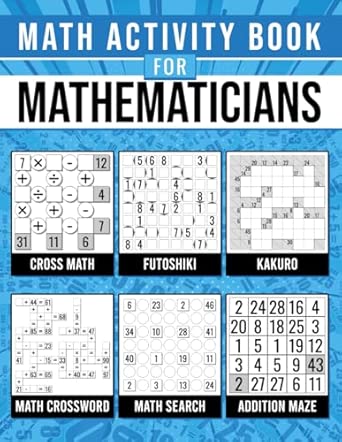 | Best for a More Focused Mix | Puzzle count: 450 | Puzzle types: 7 | Solutions: Complete solutions included | VIEW LATEST PRICE | See Our Full Breakdown |
| Challenging Math Problems |  | Best for Topic-Based Challenge | Content: Math problems and puzzles | Named topics: Algebra and geometry | Skills emphasized: Logical reasoning and creative problem-solving | VIEW LATEST PRICE | See Our Full Breakdown |
| My Best Mathematical and Logic Puzzles |  | Best for Recreational Math Fans | Series: Dover Math Games & Puzzles | Format: Paperback | Puzzle focus: Mathematical and logic puzzles | VIEW LATEST PRICE | See Our Full Breakdown |
| The Ultimate Mathematical Challenge: Over 365 Puzzles to Test Your Wits and Excite Your Mind |  | Best for Long-Term Variety | Puzzle count: Over 365 | Puzzle focus: Mathematical challenges | Difficulty: Varied levels | VIEW LATEST PRICE | See Our Full Breakdown |
| The Ultimate Math Activity Book: 405 Puzzles for Adults and Seniors |  | Best for Adults and Seniors Seeking Mental Practice | Puzzle count: 405 | Intended audience: Adults and seniors | Format: Activity book | VIEW LATEST PRICE | See Our Full Breakdown |
| The Original Area Mazes: 100 Addictive Puzzles to Solve with Simple Math and Clever Logic |  | Best for a Distinctive Puzzle Format | Puzzle count: 100 | Puzzle type: Area mazes | Skills: Simple math and logic | VIEW LATEST PRICE | See Our Full Breakdown |
| The Moscow Puzzles: 359 Mathematical Recreations |  | Best for Classic Recreational-Math Variety | Puzzle count: 359 | Series: Dover Math Games & Puzzles | Puzzle focus: Mathematical recreations | VIEW LATEST PRICE | See Our Full Breakdown |
| 300 Math Crossword Puzzles: Addition, Subtraction, Multiplication, and Division |  | Best for Operation Variety | Puzzle count: 300 | Puzzle format: Math crosswords | Math operations: Addition, subtraction, multiplication, and division | VIEW LATEST PRICE | See Our Full Breakdown |
| 500+ Math Pyramid Puzzles – Easy to Hard Mathematical Sum Addition and Subtraction Game with Full Solutions, 8.5″ x 11″ |  | Best for Self-Study and Workspace | Puzzle count: 500+ | Puzzle format: Math pyramid puzzles | Math operations: Addition and subtraction | VIEW LATEST PRICE | See Our Full Breakdown |
| Math Squares Puzzles for Adults: 101 Math Squares |  | Best for Focused Number Logic | Puzzle count: 101 | Puzzle format: Math Squares | Content: 101 Math Squares puzzles | VIEW LATEST PRICE | See Our Full Breakdown |
| math puzzle books for adult | Puzzle count | Intended audience |
|---|---|---|
| The Master Theorem | — | Puzzle enthusiasts |
| Brain Workout | 500 | Beginners |
| Brain Workout: 500 Math and Lo | 500 | Adults and seniors |
| Math Activity Book: 450 Puzzle | 450 | — |
| Challenging Math Problems | — | — |
| My Best Mathematical and Logic | Not specified | — |
| The Ultimate Mathematical Chal | Over 365 | Enthusiasts of all ages |
| The Ultimate Math Activity Boo | 405 | Adults and seniors |
| The Original Area Mazes: 100 A | 100 | All ages, including adults |
| The Moscow Puzzles: 359 Mathem | 359 | — |
| 300 Math Crossword Puzzles: Ad | 300 | Kids and adults |
| 500+ Math Pyramid Puzzles | 500+ | — |
| Math Squares Puzzles for Adult | 101 | — |
More Details on Our Top Picks
The Master Theorem – A Book of Puzzles, Intrigue and Wit
The Master Theorem suits adults who want math-adjacent reasoning wrapped in personality rather than a large, systematically graded workbook. Its puzzles mix logic, mystery, and humor, giving the solving session a more narrative feel than the format-focused practice in Brain Workout – 500 Easy Math and Logic Puzzles in 10 Types for Beginners. That makes this the more distinctive pick for readers who enjoy witty commentary alongside a challenge, but the description gives no puzzle count or specific math formats, so it is harder to judge its breadth before buying. Some problems may also test beginners, and the limited visual aids could frustrate people who prefer diagrams. Choose it for an entertaining change of pace, not for the clearest beginner instruction or the most measurable volume of practice.
Pros:- Combines logic challenges with mystery and intrigue for a more story-driven solving experience.
- Witty commentary can make difficult puzzles feel more entertaining.
- Variety of puzzle types keeps the collection from feeling narrowly focused.
Cons:- Some puzzles may be too difficult for newcomers to solve without additional guidance.
- Limited visual aids may be a drawback for readers who prefer diagram-based puzzles.
- The supplied product details do not specify puzzle count or individual formats.
Best for: Adult puzzle fans who enjoy clever writing and mystery-flavored reasoning more than step-by-step instruction.
Not ideal for: Beginners who need worked examples, or readers seeking a clearly quantified collection of math puzzle formats.
- Content:Puzzles, intrigue, and wit
- Puzzle style:Brain-teasing reasoning challenges
- Themes:Mystery, logic, and humor
- Puzzle variety:Wide variety of puzzle types
- Intended audience:Puzzle enthusiasts
- Visual aids:Limited
Our verdict“Choose this for witty, mystery-tinged reasoning challenges, but pick Brain Workout if you want explicit beginner guidance and a stated puzzle count.”
Brain Workout – 500 Easy Math and Logic Puzzles in 10 Types for Beginners with Rules, Detailed Examples and Solutions
For adults starting out with math puzzle books, this is the clearest teaching-oriented choice in the group. Five hundred easy puzzles across ten types offer variety, while rules, detailed examples, and solutions give newcomers a route into formats such as Mathrax, Crypto Math, Kakuro, and Futoshiki. Compared with The Master Theorem – A Book of Puzzles, Intrigue and Wit, this book prioritizes instruction and predictable practice over narrative charm. That tradeoff is useful when learning unfamiliar rules, but its stated easy level may leave experienced solvers wanting more resistance. The breadth can also mean readers spend time switching between formats rather than building depth in one. Pick it for an approachable introduction with answer support; skip it if you already solve these puzzle types fluently.
Pros:- Provides 500 puzzles for extended practice.
- Covers ten types, including Mathrax, Crypto Math, Kakuro, and Futoshiki.
- Rules and detailed examples help beginners learn unfamiliar formats.
- Solutions let readers check their reasoning and move past stuck puzzles.
Cons:- The easy level may feel unchallenging to experienced puzzle solvers.
- Switching among ten formats may suit variety-seekers less than readers who want depth in one type.
Best for: Adults new to math and logic puzzles who want clear rules, worked examples, and solutions before tackling harder collections.
Not ideal for: Experienced solvers seeking advanced difficulty or a sustained challenge in one puzzle format.
- Puzzle count:500
- Puzzle types:10
- Difficulty:Easy
- Included formats:Mathrax, Crypto Math, Kakuro, Futoshiki, and others
- Instructions:Rules and detailed examples
- Solutions:Included
- Intended audience:Beginners
Our verdict“Choose this as a guided starting point with abundant variety, not as a demanding book for seasoned solvers.”
Brain Workout: 500 Math and Logic Puzzles for Adults and Seniors
This edition makes the most sense for adults and seniors who want a large, mixed collection with some guidance, but do not specifically need the beginner emphasis of its similarly titled counterpart. It offers 500 puzzles across ten types, with rules, examples, and solutions; named formats include Mathrax, Calcudoku, Kakuro, and Futoshiki. Compared with Math Activity Book: 450 Puzzles Across 7 Types with Solutions, it provides more puzzles and a wider range of types, which favors readers who want variety over a shorter collection. The available description does not state difficulty levels or give detailed examples of the full format list, so buyers cannot tell how the challenge progresses. It is a practical broad-practice pick, though the overlap among formats may not satisfy readers seeking a focused advanced math text.
Pros:- Includes 500 puzzles for a substantial practice collection.
- Ten puzzle types offer more format variety than the seven-type Math Activity Book.
- Rules and examples support readers learning unfamiliar formats.
- Solutions provide a way to check completed work.
Cons:- The supplied details do not identify difficulty levels or a progression from easier to harder puzzles.
- The complete list of puzzle formats is not specified.
- Readers focused on one advanced math topic may find the mixed-format approach too broad.
Best for: Adults and seniors who want a high-volume mix of math and logic puzzles with rules, examples, and answer support.
Not ideal for: Readers who need clearly labeled difficulty progression or want an advanced, topic-specific math problem book.
- Puzzle count:500
- Puzzle types:10
- Included formats:Mathrax, Calcudoku, Kakuro, Futoshiki, and more
- Instructions:Rules and examples
- Solutions:Included
- Intended audience:Adults and seniors
Our verdict“Pick this for broad, solution-supported practice across ten formats; choose Challenging Math Problems for a more topic-led challenge.”
Math Activity Book: 450 Puzzles Across 7 Types with Solutions
Math Activity Book is a straightforward option for adults who want several kinds of math puzzles without committing to the larger ten-type spread of the two Brain Workout books. Its 450 puzzles across seven types still provide variety, and complete solutions make independent practice easier to manage. Compared with Brain Workout: 500 Math and Logic Puzzles for Adults and Seniors, it has fewer puzzles and formats, so it is the more contained choice rather than the higher-volume one. The description does not name the seven types or explain difficulty progression, which makes it harder to match the contents to a particular skill level. This suits readers who value a clearly stated, moderate-sized collection with answers; those wanting explicit instruction or known formats should favor a book with those details.
Pros:- Contains 450 puzzles, offering substantial material without matching the 500-puzzle collections.
- Seven puzzle types provide variety across the book.
- Complete solutions support independent checking.
- Aimed at adults, seniors, and math enthusiasts.
Cons:- The supplied description does not identify the seven puzzle types.
- No rules or worked examples are specified for learning unfamiliar formats.
- It has fewer puzzles and types than either Brain Workout collection.
Best for: Adults and seniors who want a varied but more contained math-puzzle collection with complete answers.
Not ideal for: Beginners who need named puzzle rules and worked examples, or buyers who want the broadest selection of formats.
- Puzzle count:450
- Puzzle types:7
- Solutions:Complete solutions included
- Intended audiences:Adults, seniors, and math enthusiasts
Our verdict“Choose this for a moderate-sized, solution-backed mix, but opt for Brain Workout if named formats and instructional examples matter more.”
Challenging Math Problems
Unlike the multi-format collections built around hundreds of short puzzles, Challenging Math Problems is aimed at readers who want problems drawn from areas such as algebra and geometry. That topic-led approach can make it a better fit for adults who enjoy working through mathematical ideas and applying creative reasoning, while Brain Workout: 500 Math and Logic Puzzles for Adults and Seniors is the stronger choice for a broad rotation of familiar puzzle formats. The tradeoff is accessibility: the description warns that prior knowledge may be needed, and some problems have limited answer explanations. That can make independent learning less satisfying if a solution gives the result without enough reasoning. Choose it for a more demanding, subject-oriented session, not as a gentle introduction or a fully guided workbook.
Pros:- Includes problems spanning topics such as algebra and geometry.
- Encourages logical reasoning and creative problem-solving.
- Can suit independent study as well as classroom use.
- Clear instructions and an organized layout are described.
Cons:- May be too challenging for beginners without prior mathematical knowledge.
- Answer explanations are limited for some problems.
- The supplied details do not state a puzzle count or identify all topic areas.
Best for: Adults with some math background who enjoy working on algebra- and geometry-based problems independently.
Not ideal for: Beginners seeking accessible puzzle rules, worked examples, or detailed explanations for every answer.
- Content:Math problems and puzzles
- Named topics:Algebra and geometry
- Skills emphasized:Logical reasoning and creative problem-solving
- Intended users:Students, teachers, and independent puzzle solvers
- Layout:Organized with clear instructions
- Answer guidance:Explanations are limited for some problems
Our verdict“Choose this for subject-based math challenges if you already have some background; choose a Brain Workout book for gentler, format-led practice.”
My Best Mathematical and Logic Puzzles
My Best Mathematical and Logic Puzzles suits adults who want a curated set of problems rather than a high-volume activity book. Its place in the Dover Math Games & Puzzles series signals a recreational-math focus, and the selection pairs mathematical challenges with logic puzzles. Compared with The Ultimate Mathematical Challenge, which advertises more than 365 puzzles and varied difficulty, this book’s appeal is its focused collection—not a stated promise of hundreds of entries or a broad difficulty ladder. That narrower scope can make it a better fit for readers who value handpicked problem types, but the available description gives no puzzle count, difficulty breakdown, or solution details. Beginners may find some problems demanding, while anyone seeking varied puzzle formats may prefer a broader activity book.
Pros:- Curated selection focuses on mathematical and logic challenges
- Part of the Dover Math Games & Puzzles series
- Aimed at recreational mathematics enthusiasts
Cons:- May be too difficult for beginners
- Limited to specific types of math and logic problems
- The provided product details do not state puzzle count or solution format
Best for: Adult recreational-math enthusiasts who prefer a curated mix of mathematical and logic problems over a high puzzle count.
Not ideal for: New solvers seeking guided examples or a clearly stated beginner-to-advanced progression, and readers who want many different puzzle formats.
- Series:Dover Math Games & Puzzles
- Format:Paperback
- Puzzle focus:Mathematical and logic puzzles
- Intended use:Recreational mathematics
- Puzzle count:Not specified
- Difficulty range:Not specified
Our verdict“Choose this paperback if you want a focused recreational-math collection; choose The Ultimate Mathematical Challenge if volume and stated difficulty variety matter more.”
The Ultimate Mathematical Challenge: Over 365 Puzzles to Test Your Wits and Excite Your Mind
The Ultimate Mathematical Challenge is the strongest fit here for adults who want a substantial supply of problems and a stated range of difficulty. With more than 365 puzzles, it offers plenty of material for regular solving, while its described levels can accommodate readers who want to move beyond easier challenges. Compared with The Moscow Puzzles: 359 Mathematical Recreations, this title has a slightly higher stated puzzle count and clearer claims about difficulty variety; the Moscow book’s description says less about its progression. The tradeoff is that a large challenge collection may not feel approachable throughout: some problems may frustrate casual readers without a strong math background. The available details also do not specify format, puzzle categories, or how solutions are presented.
Pros:- More than 365 puzzles provide an extensive supply of challenges
- Varied difficulty levels are described for different skill levels
- Designed to exercise problem-solving and mathematical reasoning
Cons:- Some problems may be too challenging for casual solvers without a strong math background
- The provided details do not identify puzzle types or solution format
- No format or physical dimensions are specified
Best for: Adult puzzle solvers who want a large collection with multiple difficulty levels to support regular practice and gradual challenge.
Not ideal for: Casual readers who prefer gentle, clearly explained puzzles or need confirmed details about solutions and puzzle formats before choosing.
- Puzzle count:Over 365
- Puzzle focus:Mathematical challenges
- Difficulty:Varied levels
- Intended audience:Enthusiasts of all ages
- Stated benefits:Problem-solving practice and mathematical thinking
- Format:Not specified
Our verdict“Pick this for a large, difficulty-varied challenge set, but choose a beginner-focused book if you want more explicit guidance.”
The Ultimate Math Activity Book: 405 Puzzles for Adults and Seniors
The Ultimate Math Activity Book makes its audience and scale clear: it contains 405 puzzles for adults and seniors, with activities covering logic and mental math. That combination makes it a straightforward option for readers who want arithmetic-oriented brain practice rather than a book framed around a narrower puzzle mechanic. Compared with The Original Area Mazes, it offers a broader stated focus, while Area Mazes centers on one distinctive format. The tradeoff is sparse detail: the description does not explain difficulty progression, puzzle variety within those categories, or whether solutions are included. That makes this harder to recommend to someone who needs guided instruction or wants to preview the challenge level. Its audience label is useful, but it does not establish that every puzzle is easy or senior-friendly.
Pros:- Contains 405 math puzzles
- Specifically intended for adults and seniors
- Includes both logic and mental-math practice
Cons:- No difficulty range or progression is described
- Solution availability is not specified
- Limited product details make the exact puzzle mix unclear
Best for: Adults and seniors looking for a sizeable activity-book collection centered on logic and mental-math practice.
Not ideal for: Buyers who need a stated difficulty progression, worked examples, or confirmation that answers and solutions are included.
- Puzzle count:405
- Intended audience:Adults and seniors
- Format:Activity book
- Puzzle focus:Math puzzles
- Puzzle categories:Logic and mental math
- Difficulty range:Not specified
Our verdict“Choose this for a clearly adult-and-senior-focused collection of 405 logic and mental-math activities, not for detailed guidance or a guaranteed difficulty path.”
The Original Area Mazes: 100 Addictive Puzzles to Solve with Simple Math and Clever Logic
The Original Area Mazes gives adults a more specific kind of math challenge than the general collections in this roundup. Its 100 area-maze puzzles combine simple arithmetic with logic, so solving depends on following the maze’s mathematical structure rather than switching between unrelated puzzle types. Compared with The Ultimate Math Activity Book, which covers logic and mental math more broadly and has 405 puzzles, this is the more focused choice; its smaller count is the tradeoff for a consistent format. The description calls the puzzles suitable for all ages, but also notes that some may challenge beginners. Readers who want variety across puzzle styles or a clearly stated progression may find the format limiting. The paperback is described as compact, making it easier to carry than a larger activity-book setup.
Pros:- 100 puzzles use a distinctive area-maze format
- Combines simple arithmetic with logical reasoning
- Compact paperback format is portable
- Described as suitable for adults and children
Cons:- Focuses exclusively on area mazes, limiting puzzle variety
- Some puzzles may be difficult for beginners
- Offers fewer puzzles than the 405-puzzle Ultimate Math Activity Book
Best for: Adults who enjoy visual, format-driven puzzles and want arithmetic and logic combined in a compact paperback.
Not ideal for: Solvers who want a wide mix of puzzle formats, a large puzzle count, or an explicitly beginner-friendly difficulty path.
- Puzzle count:100
- Puzzle type:Area mazes
- Skills:Simple math and logic
- Intended audience:All ages, including adults
- Format:Paperback
- Portability:Compact format
Our verdict“Choose Area Mazes for a portable, consistent visual challenge; pick a broader activity book if you want more formats and a larger supply of puzzles.”
The Moscow Puzzles: 359 Mathematical Recreations
The Moscow Puzzles: 359 Mathematical Recreations stands out for its substantial collection of 359 mathematical puzzles and its place in the Dover Math Games & Puzzles series. It is a natural fit for adults drawn to recreational mathematics who want a collection rather than one repeated puzzle format. Compared with My Best Mathematical and Logic Puzzles, this title has a stated count of 359, giving buyers a clearer sense of its scale; the other Dover book is described as a curated selection but has no listed count. The main uncertainty is practical: the supplied details say nothing about difficulty or solutions. That makes it a less predictable choice for beginners than The Ultimate Mathematical Challenge, which at least describes varied difficulty levels. Choose it for volume and mathematical recreation, not for a known learning path.
Pros:- Includes 359 mathematical puzzles
- Part of the Dover Math Games & Puzzles series
- Collection is presented as mathematical recreation
Cons:- Puzzle difficulty is not specified
- Solution availability and explanation style are not described
- Format is not provided in the available product details
Best for: Adult recreational-math readers who want a large collection and are comfortable choosing without a stated difficulty guide.
Not ideal for: Beginners who need a clear progression, or solvers who want confirmed information about answer explanations and puzzle difficulty.
- Puzzle count:359
- Series:Dover Math Games & Puzzles
- Puzzle focus:Mathematical recreations
- Difficulty:Not specified
- Solutions:Not specified
- Format:Not specified
Our verdict“Choose this for a sizable recreational-math collection if you can accept uncertainty about difficulty and solutions.”
300 Math Crossword Puzzles: Addition, Subtraction, Multiplication, and Division
This book suits adults who want arithmetic practice in a crossword format rather than a collection of broad logic challenges. Its 300 puzzles use addition, subtraction, multiplication, and division, giving it more operation variety than 500+ Math Pyramid Puzzles, which focuses on addition and subtraction. That range can help keep practice from feeling tied to one calculation pattern, while the crossword structure adds a placement-and-intersection element to solving. The main compromise is that the book is also designed for children, so adults looking for demanding mathematical reasoning may find its level or presentation less tailored to them. The available details do not specify difficulty progression, solutions, or page dimensions, making it harder to judge how well it supports independent study.
Pros:- Includes 300 puzzles for sustained practice
- Covers addition, subtraction, multiplication, and division
- Crossword format combines arithmetic with number placement
- Designed for both kids and adults
Cons:- The broad age range may mean the material is not specifically calibrated for adults
- No difficulty levels or progression are specified
- The provided product details do not mention an answer key
Best for: Adults who want varied basic-arithmetic practice in a crossword format and are comfortable with a book also aimed at children.
Not ideal for: Adults seeking advanced mathematical reasoning, a stated difficulty progression, or confirmed solutions for checking answers.
- Puzzle count:300
- Puzzle format:Math crosswords
- Math operations:Addition, subtraction, multiplication, and division
- Intended audience:Kids and adults
- Product type:Puzzle book
- Difficulty levels:Not specified
Our verdict“Choose this for varied four-operation practice in a crossword format, but skip it if you want adult-specific difficulty or confirmed solutions.”
500+ Math Pyramid Puzzles – Easy to Hard Mathematical Sum Addition and Subtraction Game with Full Solutions, 8.5″ x 11″
The strongest case for this book is the combination of 500+ puzzles, an easy-to-hard range, and full solutions. Those solutions make it a more self-contained practice option than 300 Math Crossword Puzzles, whose supplied details do not mention an answer key. Pyramid challenges also give the book a consistent format, while the 8.5″ x 11″ pages offer room to work through sums without crowding. Its limits are just as clear: the focus stays on addition and subtraction, so it offers less operation variety than the crossword book, and repeated pyramid mechanics may not suit readers who want a mix of puzzle types. It makes the most sense for steady arithmetic practice, not broad mathematical exploration.
Pros:- More than 500 puzzles provide extensive practice
- Easy-to-hard levels offer a path from simpler to tougher challenges
- Full solutions support independent checking
- Large 8.5″ x 11″ pages provide room to work
Cons:- Limited to addition and subtraction
- A single pyramid format may feel repetitive over a long session
- Large pages are less convenient for compact storage or travel
Best for: Teens, adults, and seniors who want a large set of progressively challenging addition-and-subtraction puzzles with answers for self-checking.
Not ideal for: Readers who want multiplication, division, varied puzzle formats, or a compact book for carrying around.
- Puzzle count:500+
- Puzzle format:Math pyramid puzzles
- Math operations:Addition and subtraction
- Difficulty:Easy to hard
- Solutions:Full solutions included
- Dimensions:8.5″ x 11″
- Target audience:Teens, adults, and seniors
- Product type:Puzzle book
Our verdict“Pick this for plentiful, answer-supported arithmetic practice with generous writing space, provided addition and subtraction are enough variety for you.”
Math Squares Puzzles for Adults: 101 Math Squares
For adults who would rather settle into one kind of number puzzle than alternate between formats, this book keeps its focus on 101 Math Squares. The stated emphasis on numerical logic and pattern recognition makes it distinct from 300 Math Crossword Puzzles, which centers on four arithmetic operations in a crossword layout. That narrower format may appeal to readers who enjoy recognizing relationships between numbers, but it also creates the clearest tradeoff in this group: there is only one puzzle type, and the book offers fewer puzzles than either the 300-puzzle crossword collection or the 500-plus pyramid book. The product details do not specify operations, difficulty levels, or solutions, so buyers wanting guided progression or answer checking may prefer a more explicitly described option.
Pros:- Designed specifically for adults
- Provides 101 distinct Math Squares puzzles
- Targets numerical logic and pattern recognition
- A focused format suits readers who prefer consistency over variety
Cons:- Limited to one puzzle type, which may become repetitive
- Fewer puzzles than the 300-puzzle crossword and 500-plus pyramid books
- The supplied details do not specify difficulty levels or solutions
Best for: Adults who enjoy numerical logic and pattern recognition and prefer concentrating on a single, consistent puzzle format.
Not ideal for: Puzzle solvers who want multiple formats, a large puzzle count, or confirmed difficulty levels and solutions.
- Puzzle count:101
- Puzzle format:Math Squares
- Content:101 Math Squares puzzles
- Target audience:Adults
- Stated skills:Numerical logic and pattern recognition
- Product type:Puzzle book
Our verdict“Choose this for a focused adult workout in number logic, but opt for a broader collection if you need variety or a longer puzzle supply.”

How We Picked
I compared the 13 books by the factors that affect day-to-day enjoyment: puzzle variety, stated difficulty, the amount of guidance or solutions described in each title, and how clearly each book serves a particular kind of adult solver. I gave more weight to a distinct, useful experience than to a large puzzle count alone. A collection that offers examples and clear solution support can work better for a new solver, while a focused book can be a stronger match for someone who already prefers a particular format.
The order reflects how well each option serves a broad range of adult puzzle fans, then how strongly it fits a narrower need. That puts a varied, recreation-led choice first, with guided beginner collections and approachable activity books close behind. Specialized formats and more demanding mathematical collections rank lower for general use, not because they lack appeal, but because their narrower style or higher challenge may suit fewer readers. I also distinguish books with explicit solution or instruction cues from those whose titles do not promise the same support.
| math puzzle books for adult | Intended audience |
|---|---|
| The Master Theorem | Puzzle enthusiasts |
| Brain Workout | Beginners |
| Brain Workout: 500 Math and Lo | Adults and seniors |
| Math Activity Book: 450 Puzzle | — |
| Challenging Math Problems | — |
| My Best Mathematical and Logic | — |
| The Ultimate Mathematical Chal | Enthusiasts of all ages |
| The Ultimate Math Activity Boo | Adults and seniors |
| The Original Area Mazes: 100 A | All ages, including adults |
| The Moscow Puzzles: 359 Mathem | — |
| 300 Math Crossword Puzzles: Ad | Kids and adults |
| 500+ Math Pyramid Puzzles | — |
| Math Squares Puzzles for Adult | — |
Factors to Consider When Choosing Math Puzzle Books For Adults
Before choosing a book, decide what you want a puzzle session to feel like: a guided warm-up, a varied workout, or sustained problem-solving. The right match depends less on the biggest number on the cover and more on how the book handles difficulty, format, and getting unstuck.
Choose a puzzle format you will return to
Math puzzle books can ask for very different kinds of attention: arithmetic fluency, logic, spatial reasoning, or a mix of several skills. A themed format such as crosswords, pyramids, squares, or area mazes can make it easier to settle into a routine, but it may feel limiting if you want each session to bring a different kind of problem. Mixed collections provide more variety, though switching puzzle rules can interrupt a short, relaxing session. A common mistake is picking by the word “math” alone without checking whether the book’s core activity sounds enjoyable. If you are unsure, favor a collection that names multiple puzzle types; if you already have a favorite, a specialist book may offer more satisfying repetition.
Match the difficulty to your preferred kind of effort
“Easy” and “challenging” describe different expectations, not a universal scale, so think about whether you want confidence-building practice or problems that may take several attempts. Beginner-oriented directions and worked examples can reduce the time spent figuring out the rules, while tougher collections may offer less scaffolding and more room to reason independently. If a book is too gentle, you may race through it; if every page feels like a test, you may stop opening it. Look for clues in the title and description about who the book serves, then choose a level that leaves room to grow. For a gift, a clearly guided collection is usually a safer bet than an advanced-sounding challenge unless you know the recipient wants harder problems.
Treat solutions and explanations as part of the experience
Answer support matters most when you plan to solve alone or use puzzles to learn a method, rather than simply compare final answers with someone else. A solutions section can help you find a small mistake and continue, but a bare answer may not explain why a less obvious path works. Titles that explicitly mention solutions, rules, or detailed examples give clearer signals about guidance than titles that do not. Do not assume every collection offers the same kind of help just because it contains puzzles; check the book’s listing or sample pages for whether answers and explanations are included. If you enjoy wrestling with a problem before checking, limited explanation may be fine; if frustration ends a session, prioritize visible guidance.
Look beyond the puzzle count
A large count can suggest plenty of material, but it does not reveal how varied the puzzles are, how many repeat the same mechanics, or how much space is available to work. A book with hundreds of related exercises may suit someone who wants steady practice, while a smaller collection of varied problems may feel fresher over time. Check whether the count covers distinct puzzles and whether the book gives you room to write directly on the page. Oversized dimensions can be handy for working through calculations, yet they may be less convenient to carry or use in a small space. Think about your real routine before treating a big number as proof of better value.
Decide whether you want a workbook or a collection to revisit
Some books work best as consumable activity books: you write answers beside the puzzles, progress in sequence, and move on. Others are better suited to dipping into a set of mathematical recreations, revisiting a problem, or sharing it with another solver. The distinction affects whether you should write in the book, use scrap paper, or keep a separate answer record. A high-volume arithmetic format may be satisfying for short daily sessions, while a problem collection can reward slower reading and discussion. If you plan to share the book or solve puzzles more than once, avoid filling pages immediately and use a notebook for working. Choose the format that fits your habits rather than assuming every puzzle book is designed for the same use.
Pay more for fit, not for a bigger promise
When comparing editions or collections, focus on features that change how you will use the book: clear instructions, useful explanations, a preferred puzzle style, and a level that feels right. More puzzles do not help if the format is one you quickly tire of, and a specialist book is not a compromise if its theme is exactly what you want. For a first purchase, a guided, mixed collection can reduce the risk of choosing a style that does not suit you. For a practiced solver, a narrower or more demanding book may offer a better match than a general activity book. The best fit is the one whose format and support make you want to keep solving.
Frequently Asked Questions
Which book is the safest choice if I am unsure what kind of math puzzles I like?
Start with a collection that signals more than one puzzle type, rather than committing to a book devoted to crosswords, squares, or area mazes. The Master Theorem is the strongest broad-interest choice in this roundup, while the guided beginner edition of Brain Workout is a more structured alternative. The first favors mathematical recreation and variety; the second makes its rules, examples, and solutions part of the appeal. If you want gentle entry points above all, choose the guided option. If you would rather sample a wider style of mathematical wit, choose the broader pick.
Do I need a book labeled for beginners if I have not done math puzzles in years?
Not necessarily: comfort with arithmetic is only one part of solving, since puzzle rules and logic can be unfamiliar even when the calculations are easy. A beginner-labeled book is useful if you want examples and clear instructions before working independently. If you remember enjoying wordplay, visual reasoning, or brainteasers, a mixed collection may suit you better than a book of repeated easy exercises. Check whether the title explicitly promises rules, worked examples, or solutions rather than relying on the word “adult.” Pick a level that feels inviting, not one that assumes you need advanced math.
Are books with hundreds of puzzles a better choice for regular practice?
They can be a good fit if you want a steady supply of short exercises, but the count does not tell you how much the puzzle style varies or whether the difficulty changes. A 500-puzzle arithmetic collection may provide repetition that helps you build a routine, while a more varied book may hold your interest longer if you tire of one format. Check for the kinds of puzzles included and the stated answer support before choosing by volume. Also think about whether you prefer to write in the book or solve on separate paper. For regular practice, a format you enjoy returning to matters more than a headline count.
Should I choose a specialist book or a mixed math-and-logic collection?
Choose a specialist book when you already know the format you enjoy and want sustained practice in it, such as math crosswords, pyramids, squares, or area mazes. A mixed collection makes more sense when you want variety or are still finding out which kinds of problems hold your attention. The tradeoff is consistency versus range: specialists can make sessions feel cohesive, while mixed books may ask you to learn different rules from page to page. For a gift, a varied book is generally less dependent on knowing someone’s favorite puzzle style. For your own use, let your past puzzle habits guide the choice.
What should I check before choosing a challenging puzzle book?
Look for signs of the challenge you want: whether the book emphasizes advanced problems, mathematical recreation, or a particular logic-heavy format. Then check whether solutions are provided and whether they offer explanations or only final answers, since that affects how useful the book is when you get stuck. A demanding collection without much guidance can be rewarding for a solver who enjoys working independently, but frustrating for someone who wants to learn a new method. If you are between levels, a book with varied puzzle types can give you a wider range of effort. Choose a challenge that invites another attempt instead of making every session feel like an exam.
Conclusion
For a single book that suits the widest range of adult puzzle fans, I recommend The Master Theorem as best overall for its recreation-led, varied appeal. My best value in puzzle variety is Brain Workout: 500 Math and Logic Puzzles for Adults and Seniors for readers who want a large activity collection; choose the easy-and-guided Brain Workout edition instead if you are new and want rules, examples, and solutions. For a premium-style, more demanding read, I would look to The Moscow Puzzles or The Ultimate Mathematical Challenge, depending on whether you prefer a named mathematical recreation collection or a broad set of challenges. For a focused format, pick The Original Area Mazes for spatial reasoning, 300 Math Crossword Puzzles for arithmetic in a crossword structure, or Math Squares Puzzles for Adults for a compact, single-format set. Match the book to the kind of problem you will actually want to solve, and the choice becomes much clearer.