
TL;DR

Prime made for students and young adults
- Fast, free delivery for dorm and study essentials
- Prime Video and Amazon Music included
- Member-only deals
Qblox says it has integrated NVIDIA DGX Spark with its quantum system controller using NVIDIA NVQLink. The company reports round-trip latency below 7.2 microseconds on DGX Spark and below 4.0 microseconds on an RTX PRO 6000 Blackwell, with potential uses in calibration and quantum error correction.
Qblox has connected NVIDIA DGX Spark to its quantum system controller through NVIDIA NVQLink, reporting round-trip latency below 7.2 microseconds on DGX Spark. The company says the integration links GPU computing with quantum hardware control, a step toward running workloads such as calibration and error correction with classical computing resources during quantum experiments.
In its announcement, Qblox reported round-trip latency below 4.0 microseconds on an NVIDIA RTX PRO 6000 Blackwell and below 7.2 microseconds on DGX Spark. These are company-reported measurements; the supplied announcement does not provide a test protocol, workload details, or independent verification. The two results refer to different GPU platforms and should not be treated as a direct comparison of otherwise identical systems.
The integration pairs Qblox’s Q1 sequence processors and LINQ with the company’s Qblox Cluster control system and NVIDIA’s GPU and software stack. Qblox says the setup can support GPU-accelerated calibration, where qubit parameters may be updated while experiments run, and quantum error correction, where syndrome data is sent to GPU-based decoders for processing.
The company describes NVIDIA CUDA-Q as a way to develop and run quantum, AI, and simulation workloads on a desktop system, with code intended to transfer to GPU servers as systems grow. That portability is part of the announced development approach; the release does not report a specific customer deployment, production-scale quantum system, or performance result for a complete error-correction workload.
Connecting GPUs to Quantum Control
Quantum devices require classical systems to control operations, collect measurement results, and respond to errors. Qblox’s announcement addresses one part of that challenge: reducing the time needed to pass information between quantum-control hardware and a GPU. If the reported performance holds under relevant workloads, the connection could help researchers test control routines that need computation during an experiment rather than only afterward.
The potential relevance is clearest for calibration and quantum error correction. Calibration can require repeated adjustments as hardware behavior changes, while error-correction methods depend on processing measurement data quickly enough to guide subsequent operations. Faster communication alone does not establish that a quantum computer can run fault-tolerant workloads, but it can provide a building block for testing those methods.
DGX Spark also gives researchers a desktop-scale platform for development, according to NVIDIA. The proposed path from desktop development to GPU servers could make it easier to move software as experiments demand more computing capacity. Whether that path works smoothly across real deployments, and what performance users will see, remains to be shown.
As an affiliate, we earn on qualifying purchases.
From NVQLink Plans to Hardware
The announcement follows earlier Qblox-NVIDIA work. The source report says Qblox announced work with NVIDIA NVQLink in October 2025 and added support for the CUDA-Q real-time API in March 2026. Qblox frames the latest result as a move from an integration architecture to measured performance on hardware.
NVQLink is presented in the announcement as the connection between GPU computing and quantum control. CUDA-Q supplies the software environment described for development and workload portability. The new announcement is therefore not a claim that a complete, scalable quantum computer has been delivered; it is a report on linking control equipment and GPU systems and measuring latency.
“Quantum computers will scale only as fast as the classical control systems around them.”
— Niels Bultink, Qblox CEO and co-founder
As an affiliate, we earn on qualifying purchases.
Performance Details Still Missing
The source material does not specify how latency was measured, which operations were included in the round trip, or how many runs informed the reported figures. It also does not say whether the measurements were independently tested or achieved under a particular quantum workload. The figures should therefore be read as Qblox’s reported results, not as an independently established benchmark.
It remains unclear whether the setup has been used in a live quantum experiment to demonstrate real-time calibration or error correction, and how its performance changes with system size or workload complexity. The announcement provides no customer names, deployment schedule, pricing, or availability details for a commercial system. It also does not claim that the integration by itself enables logical qubits or fault-tolerant computing.
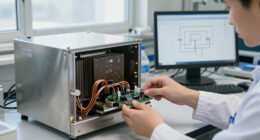
GPU accelerated quantum error correction
As an affiliate, we earn on qualifying purchases.
As an affiliate, we earn on qualifying purchases.
Evidence From Larger Experiments
The next useful evidence would be detailed benchmark methods and demonstrations using actual quantum workloads, particularly calibration updates and GPU-based error decoding during experiments. Those results would show how the reported link latency translates into end-to-end performance and whether the system can sustain the timing needs of larger setups.
Qblox and NVIDIA have not announced a date for a broader release or a specific follow-up milestone in the material provided. For now, the confirmed development is the integration and the latency figures reported by Qblox; broader adoption and performance at data-center scale remain future questions.
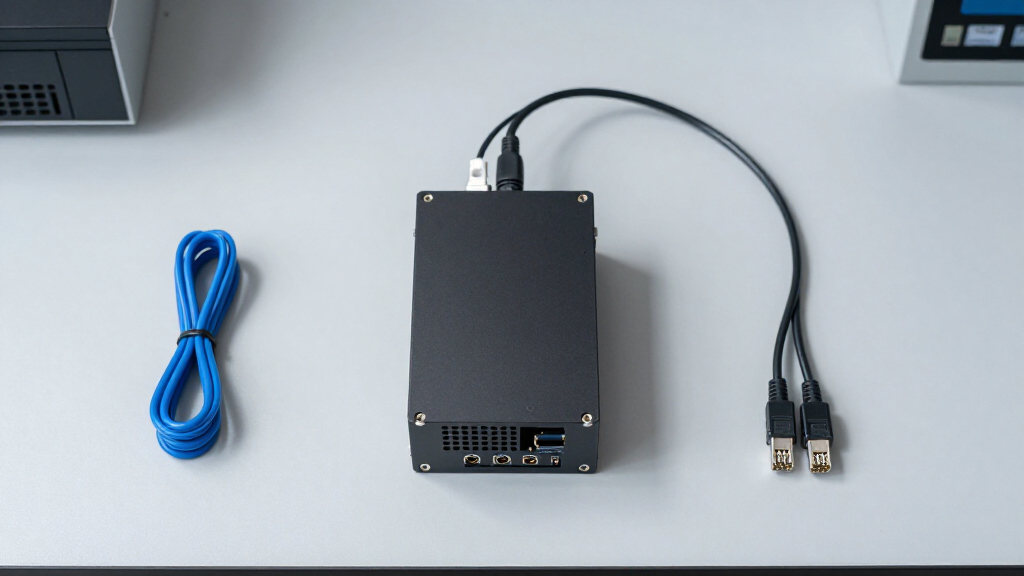
NVQLink quantum computing interface
As an affiliate, we earn on qualifying purchases.
As an affiliate, we earn on qualifying purchases.
Key Questions
What did Qblox announce?
Qblox said it integrated NVIDIA DGX Spark with its quantum system controller using NVIDIA NVQLink, connecting GPU computing with quantum-control hardware.
What latency did Qblox report?
Qblox reported round-trip latency below 7.2 microseconds on DGX Spark and below 4.0 microseconds on an RTX PRO 6000 Blackwell. The announcement does not include the test protocol or independent verification.
What quantum workloads could the integration support?
Qblox identifies GPU-accelerated calibration and quantum error correction as potential uses. The announcement does not provide a full workload demonstration or confirm deployment in a production quantum system.
Does this mean Qblox has demonstrated fault-tolerant quantum computing?
No. The announcement concerns a hardware and software integration and reported communication latency. It does not establish that a fault-tolerant quantum computer or logical-qubit system has been demonstrated.
Source: rss
Halloween Picks
halloween
As an affiliate, we earn on qualifying purchases.